Monday, May 16, 2011

THE MAKING OF A MARINE: GRADUATION


I was so taken by the graduation that I did not get many photos. Here is the bugler who started the pre-graduation festivities. It was here that several people were recognized. First of all were the DI's who served as far back as Vietnam and before that even. Sorry, I thought I had a photo.

Second of all was this dear, old man, Mr. Jack Tramiel. Mr. Tramiel is a Polish Holocaust survivor. His entire family, other than his wife, was killed in Auschwitz (I am not sure whether or not he married her after the war). 

He eventually made his way to America where he eventually became the founder of COMMODORE, yes, the company who invented the Commodore 64 home computer. He later, as CEO, acquired ATARI. He eventually retired. I sat near him. He was so freaking patriotic, singing the THE STAR-SPANGLED BANNER in his old voice while they raised the flag over Paris Island. You can't beat those old immigrants. Mr. Tramiel is in the front row with the baseball cap on. Sorry so blurry. I need to get the Iphone 4.


Ah, we got to see Hummer, Parris Island's mascot, up close. Hummer is an English Bulldog. They said that their mascots actually enter basic training, too.


The following is a group I mistakenly thought was graduating. I was a little disillusioned at first, because they kept looking at the crowd, swaying on their feet, and appearing to be distracted. I learned that they were JROTC from the local high schools. I was relieved to learn that.


They had the Parris Island band play several patriotic selections. Amazing band. We watched them raise the flag which was seriously large enough to drape over and cover a small plane. I could not help but to get really sober (without tearing up, but close). Every Marine who has died, has come from East Coast Parris Island or West Coast Camp Pendleton.

We later went over to the where the formal graduation and parade of the recruits (204, I believe, in all) graduated. Wow is all I can say. Those boys... those men... were sharp.

Sunday, May 15, 2011

THE MAKING OF A MARINE: CONFIDENCE COURSE


The Marines have a series of obstacles they have recruits master called the "Confidence Course." These obstacles are physically challenging to the individual recruit and mentally challenging to corporate groups of recruits.


Our guide was probably five feet two inches tall and built like a brick wall. Our DI introduced him as the Parris Island weight-lifting champion in his weight division.


They let us try some of the obstacles if we wanted. The obstacles started off relatively easy.


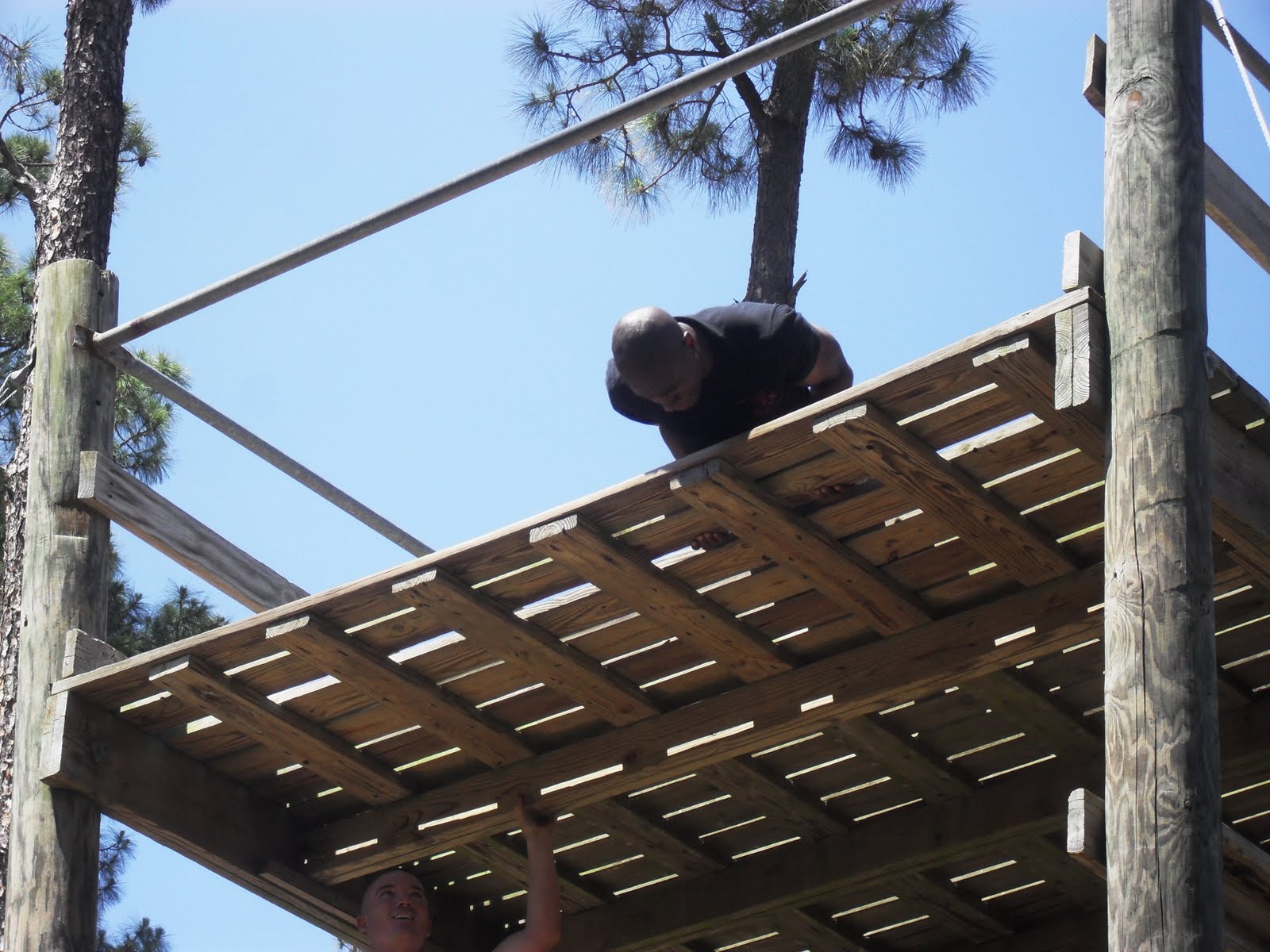
The dude above on the wall is a former Marine and works for a Huntsville-based paper. He was hilarious. We talked about the "Bed-intruder" incident & he claimed that his paper did not pick up the story because they knew it was a scam. It was a set-up, he said. The "hero" actually ended up in jail the week before our trip. 

 They wouldn't let us do this one. If the recruit fell, he had to wade out in waist-deep water.


I was so intrigued with the slide for life that I forgot to take a picture of it in action.


I forget what this was.


 This was a complicated inclined p-bar obstacle where you had to exclusively use your arms (no legs at all).


The following obstacle demanded that you advance the obstacle going over one log and under another.


Each of the obstacles emphasized personal coordination and corporate coordination. While a few of them looked easy enough, consider that these are exercises, that if duplicated in combat, become extremely difficult to accomplish.


 The classic monkey bars.


The female recruits were close by, preparing to pugil stick fight each other.


 The wall climb was rather tall. I am not sure if this obstacle required somebody help you over the wall.


The sky scraper required that three people advance, two people at any given time on one stage. I loved the brilliance behind this. It meant that if two people were above you and you were the one below, they had to wait for you or help you onto their platform before one of them could advance to the next stage. If you were the one above and there were two people below, you had to wait for both to advance before you went to the next stage. The Marines reinforce this kind of "buddy" system at every phase in recruit training. It is about the man to the right and left of you.


Our instructor was a hoss.


The pugil stick fighting was towards the end of the Confidence Course (You can see the female recruits in the background preparing to fight).


This was an interesting obstacle. Two recruits had to advance at the same time. Once they got from the second to the top. One of the recruits says "I go, you stay." The other recruit responds "I stay, you go." The Marines call this "accountability": a reciprocal understanding of an order with an acknowledgement of that order.


 Ah, if it works during war, it must work during peace.

Sunday, May 8, 2011

THE MAKING OF A MARINE: "SNAPPING IN"


The Marines refer to any sort of practice as "snapping in." Being a division of the Navy, much of their terminology comes from the parts of a ship. After a day or two, much of this language became clear to me. Here are a few examples:

A "deck" is the floor, so "Clear the deck" made sense. "Overhead" was the ceiling. A "ladder" is the stairs. "Topside" is upstairs.

A "bulkhead" is the wall (At times recruits are expected to put their heels against the wall as a spatial measurement. We were made to do this at the swimming pool).

A "hatch" is a door. Everywhere we went on the bus, a chosen one of us were made to stand by the bus "hatch" and count every person who came aboard the bus.  A "porthole" is a window (and also describes a pair of glasses). The DI would criticize the person standing out of formation by calling him a "porthole." I am not sure what that meant except to say that he was "getting in the way."


A "head" is the toilet and a "head call" is using the toilet. We were made to "hydrate" ourselves constantly by sipping water. I was surprised at how many opportunities the DI gave us to use the restroom at least once every half hour it seemed. I was also surprised at how often we needed to use it.


A "squad bay" is a barracks. We were allowed entry into the female barracks where we observed their "racks" (beds) with the neatly made hospital corners.


Oh, yes, and food is always "chow." 


Saturday, May 7, 2011

THE MAKING OF A MARINE: "WIZZOS"


The Marines refer to a Weapons System Operator as a "wizzo." I like the flow of that word. The briefing before going into the hangar was torture. Imagine being at a church service that never ended (because you didn't know the liturgy, you didn't know if you were in the middle or at the end) or imagine a college professor prepping you for an exam without a textbook or syllabus or notes of any sort except the small text on white background projected from the power-point projector: bullets of seemingly complicated facts, military jargon, and lots of figures. I kept falling asleep on the second row no matter how I tried to take notes on my Iphone. When I looked back on my notes, I found the typed portion, "Transcript is smarts" (Someone tell me what that means). I bet you I would have stayed awake were a DI around.

It wasn't at all that the information was irrelevant or that the info was necessarily boring. It was simply that we were talking with Marine officers who were college graduates, cheerful, smiley, humorous, and with a tinge of dangerously brilliant nerdiness. It was very different than the DI side of Parris Island where every muscle in you was on guard not to step out of line. A little gun shy, the pilots and support staff spoke to us about the benefits of being in the Marine Corps, why they came into the Corps, etc.


They allowed us to tour the F-18 hangar where maintenance was being done on the planes. To give you an idea of how generous the Marines were to allow us close-up access, an F18 costs 35 million, whereas the production and purchase of a new F18 costs 800 million. Short and sleek, several F18s were in various states of repair, crewmen working on planes on the other half of the hangar or out on the runway.  They had us don a pilot's helmet, climb the B-stand" (aka, "Bravo stand." By the way, none of the pilots or wizzos to whom I spoke knew why it was called a "B-stand"). The pilots were cordial.


Of the things I learned while on the hangar tour, the value pilots place on their wizzos was the most impressive. The wizzo's extra pair of eyes cuts the time of identifying and engaging targets by half. The wizzo essentially spends his time scanning the landscape through amplified video technology, looking for targets who think themselves to be insignificant subjects of interest. While the pilot sees the immediate need before him, the wizzo is watching dozens of incidents of enemy activity on the ground and calling in strikes. As one pilot told me, the wizzo makes the pilot look good. That is why they call wizzos "wizards", too.


One pilot was lauding the surgical precision of the pilot with the cooperation of pilot and wizzo. He described to me one engagement in which one wizzo was able to see the distress of a single Marine, zero in ordinance, strafe the enemy, call in support and rescue that Marine.  One Marine.


You Never Only Have One Mouse: Rule Number One

  Bluebottles & Dustbunnies I learned a rule the hard way, living in an historic house in Franklin called "Sweet Home." And th...

The People's Choice