Sunday, May 15, 2011

THE MAKING OF A MARINE: CONFIDENCE COURSE


The Marines have a series of obstacles they have recruits master called the "Confidence Course." These obstacles are physically challenging to the individual recruit and mentally challenging to corporate groups of recruits.


Our guide was probably five feet two inches tall and built like a brick wall. Our DI introduced him as the Parris Island weight-lifting champion in his weight division.


They let us try some of the obstacles if we wanted. The obstacles started off relatively easy.


The dude above on the wall is a former Marine and works for a Huntsville-based paper. He was hilarious. We talked about the "Bed-intruder" incident & he claimed that his paper did not pick up the story because they knew it was a scam. It was a set-up, he said. The "hero" actually ended up in jail the week before our trip. 

 They wouldn't let us do this one. If the recruit fell, he had to wade out in waist-deep water.


I was so intrigued with the slide for life that I forgot to take a picture of it in action.


I forget what this was.


 This was a complicated inclined p-bar obstacle where you had to exclusively use your arms (no legs at all).


The following obstacle demanded that you advance the obstacle going over one log and under another.


Each of the obstacles emphasized personal coordination and corporate coordination. While a few of them looked easy enough, consider that these are exercises, that if duplicated in combat, become extremely difficult to accomplish.


 The classic monkey bars.


The female recruits were close by, preparing to pugil stick fight each other.


 The wall climb was rather tall. I am not sure if this obstacle required somebody help you over the wall.


The sky scraper required that three people advance, two people at any given time on one stage. I loved the brilliance behind this. It meant that if two people were above you and you were the one below, they had to wait for you or help you onto their platform before one of them could advance to the next stage. If you were the one above and there were two people below, you had to wait for both to advance before you went to the next stage. The Marines reinforce this kind of "buddy" system at every phase in recruit training. It is about the man to the right and left of you.


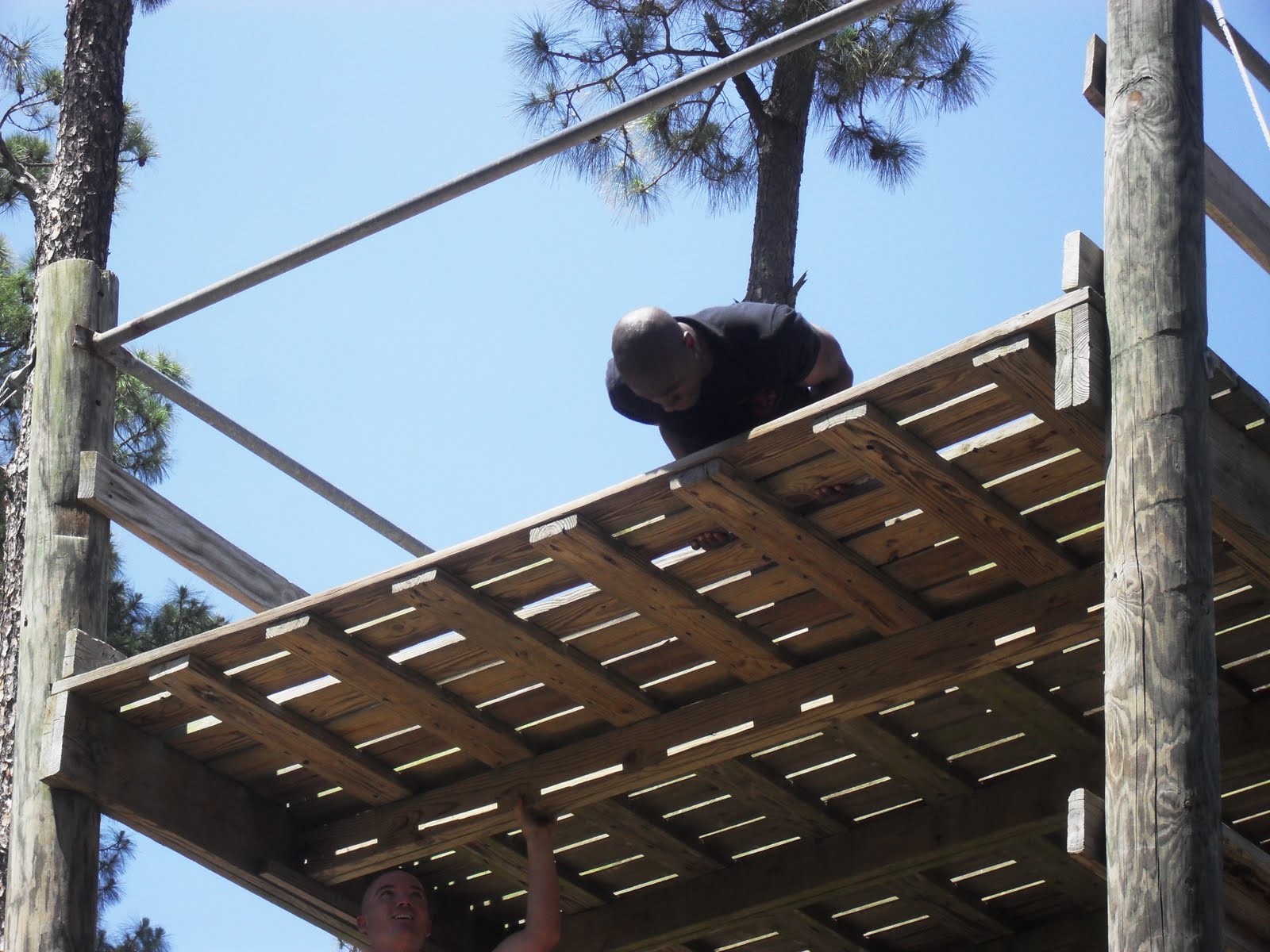


Our instructor was a hoss.


The pugil stick fighting was towards the end of the Confidence Course (You can see the female recruits in the background preparing to fight).


This was an interesting obstacle. Two recruits had to advance at the same time. Once they got from the second to the top. One of the recruits says "I go, you stay." The other recruit responds "I stay, you go." The Marines call this "accountability": a reciprocal understanding of an order with an acknowledgement of that order.


 Ah, if it works during war, it must work during peace.

Sunday, May 8, 2011

THE MAKING OF A MARINE: "SNAPPING IN"


The Marines refer to any sort of practice as "snapping in." Being a division of the Navy, much of their terminology comes from the parts of a ship. After a day or two, much of this language became clear to me. Here are a few examples:

A "deck" is the floor, so "Clear the deck" made sense. "Overhead" was the ceiling. A "ladder" is the stairs. "Topside" is upstairs.

A "bulkhead" is the wall (At times recruits are expected to put their heels against the wall as a spatial measurement. We were made to do this at the swimming pool).

A "hatch" is a door. Everywhere we went on the bus, a chosen one of us were made to stand by the bus "hatch" and count every person who came aboard the bus.  A "porthole" is a window (and also describes a pair of glasses). The DI would criticize the person standing out of formation by calling him a "porthole." I am not sure what that meant except to say that he was "getting in the way."


A "head" is the toilet and a "head call" is using the toilet. We were made to "hydrate" ourselves constantly by sipping water. I was surprised at how many opportunities the DI gave us to use the restroom at least once every half hour it seemed. I was also surprised at how often we needed to use it.


A "squad bay" is a barracks. We were allowed entry into the female barracks where we observed their "racks" (beds) with the neatly made hospital corners.


Oh, yes, and food is always "chow." 


Saturday, May 7, 2011

THE MAKING OF A MARINE: "WIZZOS"


The Marines refer to a Weapons System Operator as a "wizzo." I like the flow of that word. The briefing before going into the hangar was torture. Imagine being at a church service that never ended (because you didn't know the liturgy, you didn't know if you were in the middle or at the end) or imagine a college professor prepping you for an exam without a textbook or syllabus or notes of any sort except the small text on white background projected from the power-point projector: bullets of seemingly complicated facts, military jargon, and lots of figures. I kept falling asleep on the second row no matter how I tried to take notes on my Iphone. When I looked back on my notes, I found the typed portion, "Transcript is smarts" (Someone tell me what that means). I bet you I would have stayed awake were a DI around.

It wasn't at all that the information was irrelevant or that the info was necessarily boring. It was simply that we were talking with Marine officers who were college graduates, cheerful, smiley, humorous, and with a tinge of dangerously brilliant nerdiness. It was very different than the DI side of Parris Island where every muscle in you was on guard not to step out of line. A little gun shy, the pilots and support staff spoke to us about the benefits of being in the Marine Corps, why they came into the Corps, etc.


They allowed us to tour the F-18 hangar where maintenance was being done on the planes. To give you an idea of how generous the Marines were to allow us close-up access, an F18 costs 35 million, whereas the production and purchase of a new F18 costs 800 million. Short and sleek, several F18s were in various states of repair, crewmen working on planes on the other half of the hangar or out on the runway.  They had us don a pilot's helmet, climb the B-stand" (aka, "Bravo stand." By the way, none of the pilots or wizzos to whom I spoke knew why it was called a "B-stand"). The pilots were cordial.


Of the things I learned while on the hangar tour, the value pilots place on their wizzos was the most impressive. The wizzo's extra pair of eyes cuts the time of identifying and engaging targets by half. The wizzo essentially spends his time scanning the landscape through amplified video technology, looking for targets who think themselves to be insignificant subjects of interest. While the pilot sees the immediate need before him, the wizzo is watching dozens of incidents of enemy activity on the ground and calling in strikes. As one pilot told me, the wizzo makes the pilot look good. That is why they call wizzos "wizards", too.


One pilot was lauding the surgical precision of the pilot with the cooperation of pilot and wizzo. He described to me one engagement in which one wizzo was able to see the distress of a single Marine, zero in ordinance, strafe the enemy, call in support and rescue that Marine.  One Marine.


Thursday, May 5, 2011

THE MAKING OF A MARINE: "BUTT HURT"


The Marines refer to getting your feelings hurt as "butt hurt." Specifically, this term was associated with an incident that recently happened where educators came to view Parris Island. When given the opportunity to fight a Marine with pugil sticks, one teacher viciously attacked the Marine. The Marine responded with a dizzying blow to the educator's head which the educator decried as unfair. That is "butt hurt."


We were allowed to watch hand-to-hand combat and pugil stick fighting. This was at the beginning of a 50+ hour grinding ordeal called simply "The Crucible" where recruits, who were almost complete with their training, were put into an arena reminiscent of Gladiator (albeit a smaller version). 


Two by two, they entered into the arena (one through each of the four chutes), running as fast as they could, pugil sticks above their heads, and yelling at the top of their raspy voices. At each doorway inside the arena, a recruit with a shield stood inside the doorway, waiting to prevent the recruit charging down the chute from entering his "porthole." He did this by slamming the recruit into the wall.


Some of these boys looked like they had never fought before. Some of them fought liked they had (especially several of the tatted ones). If the instructors did not believe the recruits to be fighting hard enough, the refs would stop them, sometimes sending them out to do crunches.


After a minute or two, the instructors would make them lie their sticks at the front of their doors, come back to the middle, and lie on their backs in the sand with their heads together. When he blew the whistle, they had to get up, retrieve their pugil sticks, and fight again.


The pugil stick exercise actually taught the recruits how to fight using their rifles. It is the length of the rifle, and the placement of the hands are roughly the same distance from the rifle butt to the handgrip near the barrel. When recruits were finished, they were made to line up outside the arena against the wall. One recruit signed me.


It was eerie watching these recruits go at it, especially as many of them (I am sure) were prevented from having these kinds of fights growing up. The recruits had no idea who was waiting for them in the arena. Sometimes the sizes were woefully unmatched. But it didn't matter. I watched a Hispanic recruit barely five feet pummel this kid who stood over six feet.

There was no "butt hurt" here. It was about resolve before you see how large your opponent is. It is about representing your battalion. It was about pushing beyond yourself to do what needed to be done under the watch of your DI (none but the four recruits inside the arena could see what was going on as the chutes were angled). But they could hear the blows, the shouts from the refs, the whistleblows, and the cheers or instructions from the DI's (which, interestingly, had a lot to do with food like "Recruit, eat him up" or "Recruit, I don't want seconds"). Regardless as to how built these recruits were, I saw men with mental resolve that would outlast mine by light years. 

Standing on the upper deck, looking down upon the recruits, many of the South Carolinian educators egged the boys on. I stood grimly, making eye contact with the underdogs who were finished and lined up to go through again. All I could do was to give them secret thumbs up. They stared back at me or else nodded their heads. 

I had an opportunity to pugil stick battle a Marine, but I chose not to do it. So I beat a Marine or he beats me, and what is learned? It doesn't really count. Many of the educators were trying to beat the hell out of the Marine instructor and others applauded when he would get in a good hit. 

I was seriously in too sober a mood and had too much respect for the Marine-making process and for these recruits who felt they were on display. I will save beat-downs for cocky educators. Maybe I am butt hurt at how too festive the mood was amongst us.

THE MAKING OF A MARINE: "ONION RING AND FRY"


The Marines refer to the site on an M-16 as an "onion ring and fry." The idea is that you want the "fry" to bisect the length of the "onion ring" through the radius, setting your radius upon your target. We had a briefing on this that was very specific about the analogy (As an aside, it seems the Marines begin every brief with a history lesson, underscoring that every Marine should know his history. That reason contributes to why Marines carry themselves so well. They know where they came from).

Every Marine is first a rifleman, so each Marine is expected to qualify as a riflemen. We were taken into a rifle simulation room where there was a platform holding rifles and magazines at one end of the room and a screen at the other end. The screen projected four targets, with circles on the target where the heart and head should be (Four people at a time could shoot. The rifles and magazines communicate with sensors the hits on the target). We were taught the "Groucho" stance and were instructed to raise the rifle halfway, then full on the target, aim, and then shoot.


A Marine explained to me the lack of wisdom in hitting your target only once. The M-16 leaves a puncture wound, of course, but the body will compensate for the wound by rushing blood into the hole to stanch it. "Double-tapping" or, better yet, hitting the target three times in a combination of head and heart insures that the body has no sufficient blood to stanch three vital wounds. Marines are scientists when it comes to war.

They had us shoot downrange with the wind blowing towards us and to the east. We were told to shoot to the left of the target to counter the wind. It worked. 


By the way, the nice man shooting to the left of me is a great shot with 6000 acres in his Tennessee backyard to practice. The brass shells of his bullets kept smacking me in the left temple. Oh, they scanned us with metal detectors to make sure we weren't taking any brass shells out with us. Evidently, a while back some Marines personally made over $150,000 by reselling brass shells. Marines are also businessmen of war. Hahaha. Brilliant.


THE MAKING OF A MARINE: "IRON DUCKS"


The Marines refer to a non-swimmer as an "iron duck." Walking into the Parris Island swim facility, you could hear a pin drop, except for the clarion orders of the Marine in charge and the short, affirmative responses of the Marines beneath him. Marine swim gear in this facility consists of khaki swim shorts and a sleeveless blouse (Marine green on one side and white on the other). 

East of the Mississippi, Parris' Island's swimming pool is second in size only to Atlanta's Olympic pool and built by the same contractor. The pool graduates in depth in at least six different places from shallow to about 10 feet (or more. I didn't think to count. I was paying attention to orders). The water level was literally flush with the top of the pool at every depth, not a centimeter less, not a centimeter more.

They had us walk to the extreme end of the pool, take a sharp turn to the right and file to a standing position in front of the bleachers in successive rows, heels against the concrete seats. The Marine in charge had legs so defined you could see the striations of his muscles. The other four Marines who assisted him were jacked with bodybuilder builds and expressionless faces.

The Marine briefed us on pool safety, and like every Marine squadron I have visited thus far, he emphasized accountability: the importance of call (orders) and response (confirmations) in the execution of every action. The Marines have this sort of protocol for everything. Even a drowning Marine has protocol he has to follow. And he has to follow it. No exception.

The Marines have thought about everything. The Marine in charge showed us how to use military-issued pants as a flotation device, and he showed us three ways to inflate them (He also showed us how to use a military blouse as a flotation device, too). His Marines illustrated the basic strokes every Marine has to master in order to pass the course.

They have changed the swim program based upon the needs of Marines in the war this past decade. Evidently, they have experienced many fatalities in water-related situations where a vehicle rolls over and Marines drown or where Marines, having to be in water for an extended period of time in combat situations, become distressed and drown. 

All Marines who pass the course must swim with boots on. That is the new rule. They must also learn to tread water with rifle, vest, and kevlar helmet on. They also learn to systematically get rid of them while treading water. What I find amazing is that the Marines get kids to swim within one week (two at the most), even if they've never seen a swimming pool. 

Wednesday, May 4, 2011

THE MAKING OF A MARINE: "GO-FASTERS"


The Marines refer to tennis shoes as "go fasters." What a brilliant name. The DI (drill instructor) explained that tennis shoes supposedly make you go faster than boots, high heels, or other sorts of shoes. So "go fasters" is a name that best describes the outcome they promise. 

Recruits who wear "go fasters" are easily identified as beginners. In fact, I found myself feeling sorry for any recruits I saw with go fasters on. I watched a platoon of recruits wearing white "go fasters" and yellow belts. The lead recruit was carrying a yellow banner. These kids were frantically trying to keep up with their drill instructor's orders and seemed especially frantic if one or two of them were singled out for bombastic criticism. These were in the "First Phase."

After watching these recruits in the "First Phase" and comparing them to the recruits in the "Second Phase", you saw a world of difference. The first thing you noticed was how less jittery the "Second Phasers" were. They were still given brash treatment by the DI's, but they didn't respond with frenetic movement (the intent of which seemed to make themselves look better than the men standing next to them). The "Second Phasers" took their medicine with no distinguishable on their face. Not even resolve. There was nothing on their faces but compliance.

The "go fasters" for "First Phase" psychologically make sense. For the first few weeks or so, it is the only non-military article of clothing you wear, a carryover from civilianhood. It is a comfort. A reminder that you are straddling two worlds. A little bit of individualistic familiarity with a lot bit of the new community with which you want to be a part. Your last illusion that you can outshine others around you in order to make yourself stick out if you must.


But you don't want to stick out. Believe me.


Here are a few of my favorite "go fasters." The first is the Vibram Five Fingers. These shoes are designed for Parkour or for basic strength training. Having no full sole, you have to employ the individual muscles of your feet to walk or run or climb. 


These are Adidas wrestling shoes. I owned a pair of royal blue wrestling shoes in college that had Olympian wrestler Dan Gable's signature. I lent them to an acquaintance of mine named "Nip" from Chicago. His parole officer found him a week later, hiding out at my college. He was taken into custody, and I never got the shoes back.
I own a pair of black and silver Nike indoor soccer shoes, but I like these because they are a classic brand. Even if I can't play soccer well, I look like I can. That is important.


Tuesday, May 3, 2011

GOD'S SIMPLE PLAN FOR EXTRA-TERRESTRIALS


When I was not developing my gymnastics abilities, I spent the majority of my tween years philosophizing to no good end. At the coffee shop. On the sidewalk. In the grocery store. At work. With the cashier. With the policeman. With the neighbor. With the total stranger on the sidewalk. At work. When talking on the phone. When swinging on the parallel bars. When watching movies. When taking the trash out. Philosophizing never made me any money, but it was one of those enjoyable ventures into which I didn't mind investing every asset, including precious brain cells.

I actually had encouragement from an eclectic brotherhood of philosophizers who, to be quite honest, were more interested in the rhetoric of presentation than in the discovery of actual answers to the problems we posed to ourselves and others. Topics ranged from ethics to politics to education, to sociological concerns, each framed within an ethereally  theological construct we found elusive enough to differentiate a myriad of original-sounding topics, plagiarizing the brilliant parts and bumbling through the disjointed ones. 


Of all the subjects we argued about, however, we never talked about aliens. And I have wondered about them for over a decade at least (My children are not afraid of monsters at night. They are afraid of aliens. They don't dream about monsters. They dream about aliens). The existence of aliens has been taken seriously since well before Spielberg's Close Encounters (1977) and ET (1982). I have actually had my own thoughts about aliens. For example, if you had the opportunity to evangelize an extra-terrestrial life-form, how would you do it? 


The first relevant question would be To what end would you evangelize them? I mean, what do you know about them to even have a need to evangelize them? Do you intend to colonize said alien race to the end that you diminish their power (very much like the ancient Pharaoh did to the Israelites)? Do you intend to build within them a subservient spirit to the end that compliance to New Testament platitudes you pick and choose to preach render them intellectually and functionally impotent to fend for themselves? 


Or do you intend to provide an ideological superstructure to the end that each successive generation of aliens, being subject to your elitist cultural prototype, becomes more and more isolated from their own alien race (after all, there is nothing even remotely redeemable in it) to the end that they have no culture of their own and must by the sheer gravity of your culture stacked against them become (at best) inferior replicas of your very own? 


Maybe their language is unacceptable, having all of the linguistic and world-view trappings of an "other-planetary" culture you cannot stomach? So you teach them King James English to the end that the salvific, cultural transfer has a chance to catch and to endure, transforming alien terms like "klj^doqp", which is derivative of "kljdq^yrp" which refers to the "Great Enlightenment" (a "supernova") of the XVI epoch of the rule of the W^/vh in which sanctions were put upon the filthy practice of Gl^n (which is too inappropriate a topic for me to discuss in this blog). That term, by the way, was the closest the Jupillian people could associate with the word "transgression." But the powers that be deemed the term etymologically inferior to the word "sin" which (add an "^") roughly means "tickle." So the Juppilians, misunderstanding an injunction associated with the term, outlawed any sort of playful touch, and involuntary itches carried with them the equivalent stigma the "wet dream" has in our culture.


What mode would you use? Physical force? Probably not, because the Juppilians each have five arms and a diaphragm that pumps like a pipe organ. Intellectual force? Their brains have a baseline functionality on par with the MacBook Air. No, what you would need to do is to create a default switch that leaves them helpless for a mere three hours a week, whereby you could upload viruses onto their "hard-drives" (I know Macs don't "have" viruses, but bear with me) that would systematically render them less and less logically competent. Of course, it is "tinkering." But it is for the glory of God, so who cares?


Of course, the mode cannot appear to be anything less than normal custom that needs no apology or explanation, no legitimate story. "This is what everyone does" should be enough, and if they object we could even say "This is what ^-^- taught us to do." Combined with the ethically spurious deprogramming, that might have a chance to work. Before long, we have a nice, fat document we call "God's Simple Plan of Salvation for Aliens" that any alien (if it really read it and followed its dictates wholeheartedly) would find itself becoming a fine specimen like ourselves. 


But isn't that the big problem in the first place? The "Plan" we have for them is not the same "Plan" we have for ourselves. In fact, their "Plan" is way too constricting than our own. The "Plan" we have for ourselves is less dogmatic and more open-ended, less specific and more ambiguous, less angry and more merciful than theirs. 


Oh, but there is a further problem. We make no correlation between the alien and ourselves. Probably because we see no similarity between the alien and ourselves. In fact, it takes everything in us not to react in genuine horror when we come face to face with them. We are bigots and even privately refer to said alien people-group in question as "Juppies" (But only when they are not listening). All of that theory. All of that conniving. All of that translating. All of that missionarying. And to what end? 


We don't know. All we know is that we cannot let a race of aliens have the edge on us. It would mean the end of life as we know it. Even if that life is inferior, it is familiar. It is ours. It is comfortable. So if stopping the aliens means infusing their culture with the virus of an inferior Gospel, then let it be, amen. Notwithstanding. If a race of aliens truly exists, wouldn't their deepest need be the same as our very own?


Look at it even more carefully, and we might realize that we did not consider what exactly it was about the aliens that needed saving. You know why? Probably because we each do not really know what it is in each of us that needs saving. Afterall, who wouldn't want to be like you?

You Never Only Have One Mouse: Rule Number One

  Bluebottles & Dustbunnies I learned a rule the hard way, living in an historic house in Franklin called "Sweet Home." And th...

The People's Choice